

 Discover the latest scientific publication of EQUBITFLY in Nature Comm. by S. Takada et al.
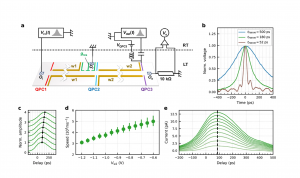
Eigenstate control of plasmon wavepackets with electron-channel blockade
S. Takada, G. Georgiou, J. Wang, Y. Okazaki, S. Nakamura, D. Pomaranski, A. Ludwig, A. D. Wieck, M. Yamamoto, C. Bäuerle & N.-H. Kaneko. Nature Comm., 16, 9942 (2025).
DOI: https://doi.org/10.1038/s41467-025-64876-z
Abstract:
Coherent manipulation of plasmon wavepackets in solid-state systems is crucial for advancing nanoscale electronic devices, offering a unique platform for quantum information processing based on propagating quantum bits. Controlling the eigenstate of plasmon wavepackets is essential, as it determines their propagation speed and hence the number of quantum operations that can be performed during their flight time through a quantum system. When plasmon wavepackets are generated by short voltage pulses and transmitted through nanoscale devices, they distribute among multiple electron conduction channels via Coulomb interactions, a phenomenon known as charge fractionalisation. This spreading complicates plasmon manipulation in quantum circuits and makes precise control of the eigenstates of plasmon wavepackets challenging. Using a cavity, we demonstrate the ability to isolate and select electron conduction channels contributing to plasmon excitation, thus enabling precise control of plasmon eigenstates. Specifically, we observe an electron-channel blockade effect, where charge fractionalisation into cavity-confined channels is suppressed due to the plasmon’s narrow energy distribution, enabling more stable and predictable plasmonic circuits. This technique provides a versatile tool for designing plasmonic circuits, offering the ability to tailor plasmon speed through local parameters, minimise unwanted plasmon excitation in adjacent circuits, and enable the precise selection of electron-channel plasmon eigenstates in quantum interferometers.